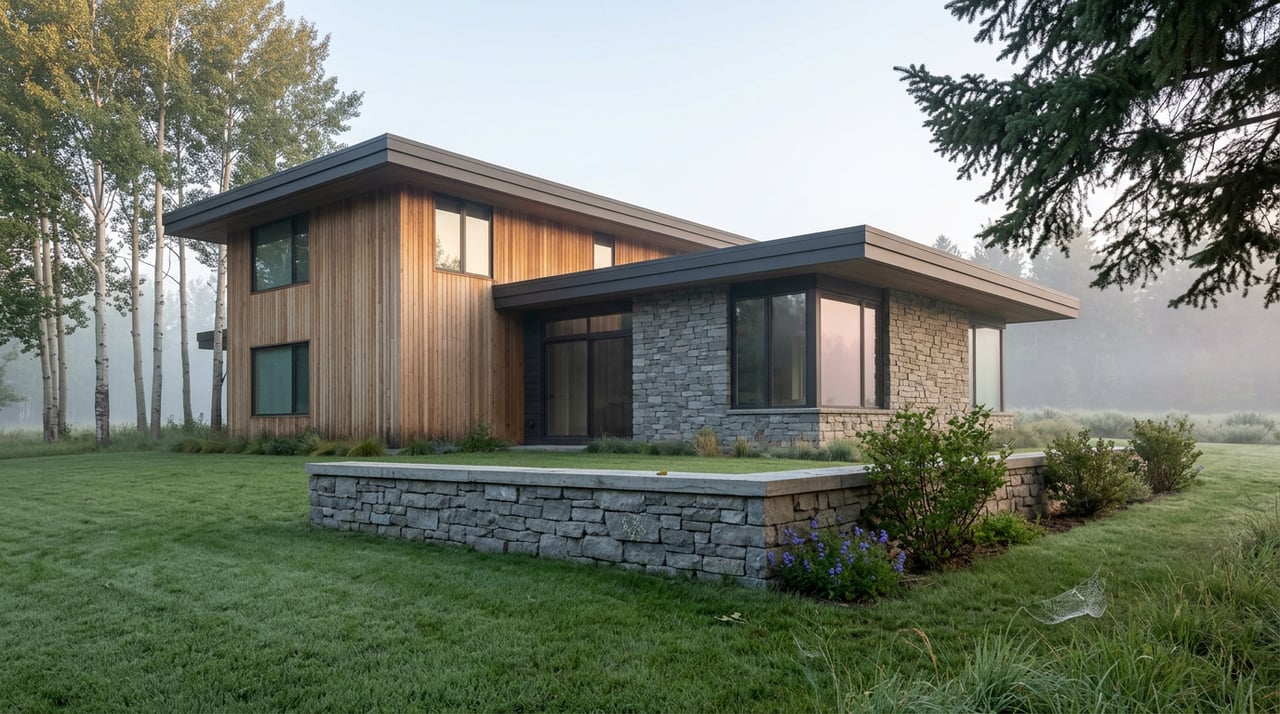
Walk out from most properties on Old Ranch Road in the last hour of light and you will eventually hit pavement that was not put there for cars. It is the McLeod Creek Trail, and if you follow it north instead of turning back toward the house, it will carry you past aspen groves, over a footbridge, and dump you out directly across State Route 224 from the big white barn that appears on every postcard of this town. Most people who buy into this neighborhood are drawn by the acreage, the mountain views, the sense of separation from the crowds on Main Street. What they discover after a season or two is that Old Ranch Road is not actually separate from anything. It is stitched, by a single paved path, to the most public and most visited piece of ground in Park City.
That is the part of this address that does not show up in the marketing. Old Ranch Road reads as private and self-contained. On the ground, it functions as the quiet residential hinge between the town's civic heart and its backcountry, closer in practice to the middle of Park City than the seclusion narrative suggests.
The paved route nobody advertises
The McLeod Creek Trail starts near the Snow Creek Medical Center, merges with the Olympic Parkway Trail along the creek for about a mile to Meadows Drive, then parallels Highway 224 for another four tenths of a mile before reaching the Farm Trailhead. From there the surface stays paved as it winds through the aspen groves above the barn, past a handful of interpretive signs and shaded benches, ending at a building with working restrooms and a water bottle filling station. The full out and back covers six miles with only 305 feet of elevation gain, an easy two to two and a half hour round trip according to trail data, which is another way of saying a dog, a stroller, and a beginner cyclist can all handle it without a second thought.
The detail that matters for anyone living on Old Ranch Road itself is where the trail actually opens up. Trail guides describe the corridor turning from wooded singletrack into open country right at Old Ranch Road, and Willow Creek Park sits at the literal intersection of Old Ranch Road and Split Rail Lane, doubling as a parking and access point for the whole system. You are not driving to a trailhead from this neighborhood. You are already standing on one.
The ranch's history on this street
The barn at the end of that trail has a history that loops back to this street in a way most visitors walking past it have no reason to know. The land was first homesteaded by the Harrison McLane family in 1886. Dan and Isabell McPolin bought the farm ten years later, in 1896, and their children Patrick and Grace inherited it in 1922, building the barn that still stands today out of recycled timber from an old tailings mill, fitted together without a single nail.
In 1947, Patrick McPolin was in a hurry. He wanted out of the dairy business and into oil in Vernal, and he needed to sell his father's estate fast. A veterinarian named D.A. Osguthorpe, who went by Doc and spent his working days treating the horses and mules that hauled ore underground at the Silver King and Mayflower mines, had admired the property for years. The two men shook hands in town and a thousand dollars sealed the deal on the spot. Doc moved his family in before the title had even cleared and had fifty dairy cows in the barn by October.
Here is the piece that ties the story back to this exact street. Two years before he bought the McPolin farm, in 1945, Doc Osguthorpe had already purchased a ranch of his own nearby, on Old Ranch Road, according to the Park City Museum's own account. The barn and the Old Ranch Road parcel were acquired by the same family two years apart.
The barn itself only reopened to the public after a $1 million restoration completed in 2017. Barbara Martz, who sits on the Park City Museum board, captured why that kind of continuity matters when she spoke at a preservation event this past May. "I like to be places where I can feel the history," she said, as reported by KPCW. That feeling is not abstract on this street. The street's connection to the barn goes back to 1945.
What is actually happening at the barn this season
Park City purchased the farm outright from the Osguthorpe family for $4.4 million in 1990, and the barn earned a spot on the National Register of Historic Places in 2004. Today it is maintained by a volunteer group called Friends of the Farm, and their 2026 calendar gives residents a real reason to keep walking that trail past midsummer.
The organization is running three docent-led tours of the barn and farmhouse this year, on July 18, August 15, and September 12, each with sessions at 4 and 5:30 in the evening. The tours cover the property's arc from homesteading to dairy operation to protected open space, told by volunteers who know the details firsthand. Earlier in the season, Friends of the Farm hosted "Your Barn Door Is Open" on June 13, a fundraising evening with a catered dinner, live music, and dancing inside the barn itself, one of the only nights each year the space gets used that way. In May, Park City Municipal used the barn as the site for its first-ever Historic Preservation Month celebration, drawing in partners like the Park City Museum and the Utah State Historic Preservation Office for an open house that Martz and others say drew people back to a landmark that spent years boarded up and fogged over before restoration. When fall arrives, the Scarecrow Festival returns to the barn on October 3, with straw stuffing provided by the farm and finished scarecrows lined up along the bike path for the rest of the season.
None of this requires a car. Every one of these events sits at the end of a trail that starts at the edge of the neighborhood.
The park at the corner, and the view from above
Willow Creek Park, right where Old Ranch Road meets Split Rail Lane, rounds out the picture of what daily life here actually looks like once the trail leaves the estate lots behind. The park has a full-size playground, courts for tennis, pickleball, volleyball, and basketball, soccer fields, and a dedicated dog park, all within easy walking distance for anyone on this side of the neighborhood.
For a wider view of how tightly all of this fits together, the Quarry Mountain Trailhead sits on the ridge that divides Old Ranch Road from Park Meadows and the farm land below. Local trail guides describe it as the point where you can see the whole arrangement at once, from Old Ranch Road across to Trailside and Jeremy Ranch. Standing up there, the estate lots and the public trail network stop looking like separate systems. They look like one continuous piece of ground that a handful of families have shaped for 140 years, dating back to the original 1886 homestead.
That is the real character of this street. It carries the word "ranch" in its name for a reason that has nothing to do with real estate branding and everything to do with its ranching history. Anyone considering property in the Old Ranch Road area is not just buying acreage and a view. They are buying into a corridor with a documented history that predates the ski industry entirely, something that shows up in very few other pockets of the Park City market.
If you are weighing what a property on this street or elsewhere in the Snyderville Basin actually offers beyond the listing photos, Timeless Properties has spent decades tracking how neighborhoods like this one actually live day to day, not just how they show on a tour. Reach out to schedule a free consultation with principal broker Jake Doilney and talk through what a place like Old Ranch Road means for your own plans.